Let's compare Fiable and the alternatives
We explore what sets us apart and when each option makes the most sense.
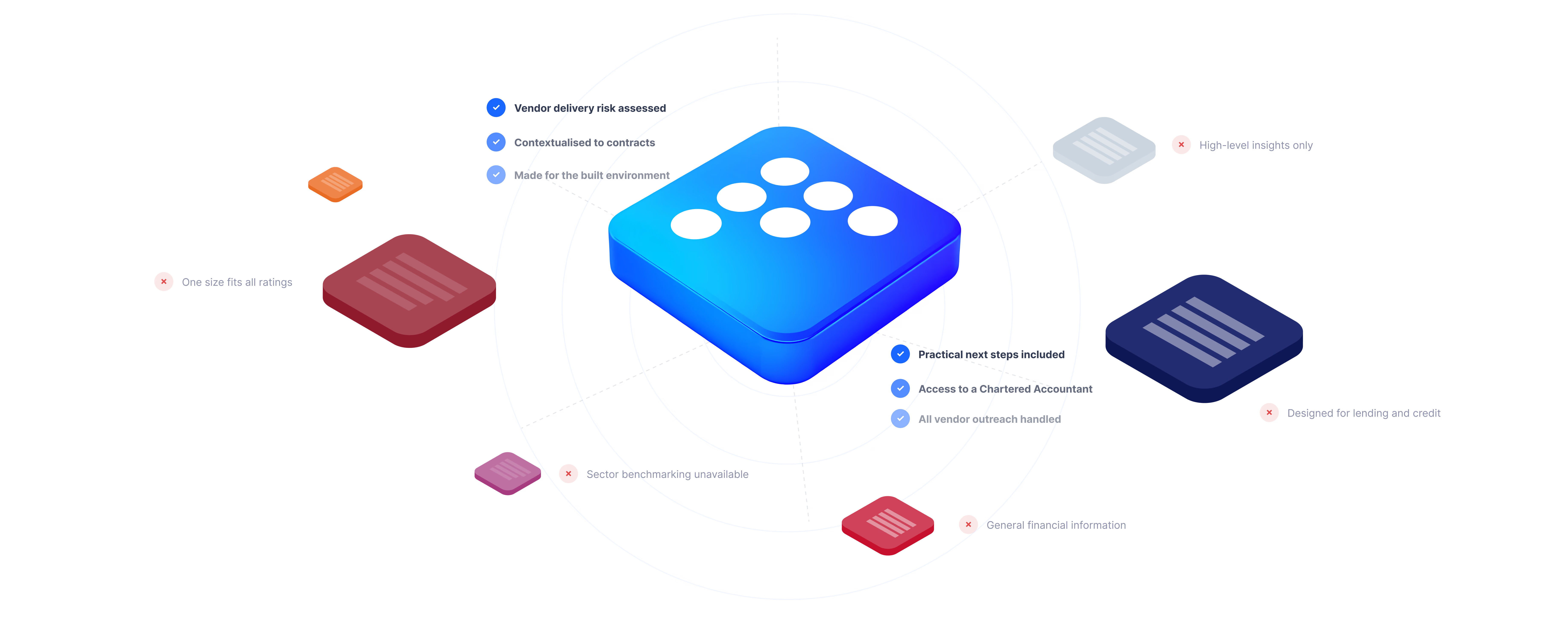














What is Fiable?
Fiable is a financial due diligence and risk assessment platform for contractors.
It’s purpose-built for the built environment, and offers different solutions for assessing a vendor's delivery risk.
The analysis examines the specific procurement, contract, and project‑delivery factors that matter in the built environment producing assessments that reflect how vendors are actually engaged.
Designed for: Delivery capacity and delivery risk
What are the alternatives?
Most of the alternatives are broad credit reporting and data analytics services.
They collect credit information across many industries and provide general financial and identity‑related insights.
They are primarily designed for credit evaluation, lending or identity verification. Their assessments draw on large credit and business data to produce general indicators of creditworthiness.
Designed for: Lending and credit
We all collect
We collect information about companies and present it in a structured format.
We all process
We aggregate the data so it's useable for further analysis.
We all analyse
We interpret data to indicate performance and risk.
Assess risk against a contract
Assessments are tailored to the specific contract you are reviewing for the vendor.
The analysis considers the contract value, duration, location and scope so you can understand whether they have the capacity to deliver the work.
Tailored commentary and guidance
Assessments include recommended risk-mitigation actions to help you proceed safely if you choose to award the contract.
We also provide suggested questions to ask the vendor, giving you a structured way to address concerns directly.
Analyse the vendor’s private data
The Financial Viability Assessment examines financial statements, liquidity, profitability, leverage, cash flow, project pipeline, company structure and more.
It provides a comprehensive, contextual view on a vendor’s capacity to take on new work.
Made for the built environment, not general lending decisions
We assess contract value, workload, forward pipeline, and the financial capacity needed to deliver a project.
Alternative solutions only provide broad business or financial risk information, but they do not assess these construction‑specific factors that influence whether a vendor can perform.
How we achieve this:
- We size financial capacity against the specific contract value being awarded.
- We factor in workload, pipeline, and current commitments to assess delivery capability.
- We collect project‑specific operational and financial information directly from vendors.
Risks without Fiable:
- Procurement teams may rely on risk data that doesn’t reflect contract or delivery conditions.
- Vendors may be approved based on generic business indicators rather than project suitability.
- Projects may be exposed to financial instability that broader tools cannot detect.
Assesses delivery risk, not just financial history
We evaluate whether a vendor can deliver the contract under real project conditions, not only how they’ve performed in the past.
How we achieve this:
- We factor current workload, resource capacity, and pipeline to gauge ability to take on new work.
- We model financial headroom against upcoming cash demands tied to the contract.
- We collect delivery‑relevant inputs (e.g., margin pressure, payment cycles, supply dependencies).
Risks without Fiable:
- Past results are mistaken for present capacity to perform.
- Early delivery strain goes undetected until it impacts timelines.
- Awards go to vendors unable to sustain project pressures.
Benchmarks against trades, not just consumer and business data
We compare vendors to peers within the same trade to surface construction‑specific risk signals.
How we achieve this:
- We map results to trade categories and benchmark against peer distributions.
- We track trade‑specific indicators (e.g., typical margin profiles, cash conversion norms).
- We highlight outliers relative to current conditions in each trade.
Risks without Fiable:
- A vendor looks stable on paper but is materially weaker than peers in the same trade.
- Trade‑level collapse trends (e.g., concreters, formworkers) go unnoticed until failure hits your project.
- Project teams underestimate risk because benchmarks weren’t construction‑specific.
Reflects real project exposure, not generic risk
We align viability to the size, duration, and dependency of the specific contract and project.
How we achieve this:
- We size financial capacity and risk thresholds to the actual contract value and terms.
- We assess concentration risk across your projects and suppliers.
- We model scenario impacts (delays, variations, extended terms) on liquidity.
Risks without Fiable:
- A vendor takes on a contract larger than they can financially support, leading to collapse mid‑delivery.
- A single vendor becomes a hidden point of failure across multiple active projects.
- Major project delays trigger liquidated damages, commercial disputes, and reputational fallout.
Analyses project-specific data, not generic information
The analysis and our methodology is always industry-focused, taking into account real delivery risk signals.
How we achieve this:
- We ask for your contract details before making the vendor assessment, such as contract value and location
- We also analyse a vendor's sector, looking at any factors which may impact their business
- Part of the assesment outcomes also include a project capacity limits
Risks without Fiable:
- Variations, extended payment terms or sequencing pressures push a vendor into distress without warning.
- Project teams approve a vendor who looks fine generally, but it overstretched in your project's timing window.
- A vendor's financial position deteriorates because of another project, impacting yours unexpectedly.
Produces forward-looking risk signals, not backward looking scores
We flag emerging stress before defaults or adverse filings, enabling action ahead of failure.
How we achieve this:
- We track directional changes in liquidity, margins, and working‑capital strain.
- We monitor shifts in workload, pipeline timing, and cash‑flow coverage.
- We generate alerts when indicators cross certain thresholds.
Risks without Fiable:
- Issues only become visible once the vendor is already failing.
- No time to adjust plans or replace them before delays hit the project.
- Insolvency lands without warning, causing stoppages and re‑procurement costs.
Uses real financials, not just credit files
We base assessments on verified management accounts and contract‑relevant financials, not only public credit records.
How we achieve this:
- We collect management accounts, cash‑flow statements, and tax information directly from vendors.
- We standardise and validate submissions to ensure comparability and integrity.
- We analyse liquidity, short‑term obligations, and cash coverage against the contract.
Risks without Fiable:
- Severe cash‑flow problems remain hidden because credit files lag months behind reality.
- Vendors “pass” a credit check but are weeks away from insolvency due to tax arrears, margin erosion, or delayed payments.
- Contractors learn of financial distress only when the vendor walks off the job or enters administration.
Fiable vs alternatives
A side-by-side look at how Fiable compares with generic alternatives.